
Marble and Stone Table Tops — and the Bases to Go Under Them
We make the stone table top, whether it is a marble table top or one in quartz, porcelain, cultured marble or granite. That is the part that comes out of our workshop, cut to your size and shape with the edge worked. We also make more than 100 models of metal table base in our steel workshop, so you can order a finished table rather than a slab. If you already have bases, or you do not like ours, order the tops on their own — that is a normal order here, not an exception.
A quartz table top is the practical choice for restaurants and cafés, since it needs no sealing and shrugs off wine and coffee. A sintered stone table top is the same porcelain top under its other name, and the lightest of the five materials to move.
See your table top in every slab we make
Pick a shape, then change the stone. Every slab shown here is one we hold or make, and the model code under each one is what you quote when you enquire.
How many people, and how big
Almost every table enquiry starts with a number of seats rather than a dimension. Allow 600 mm of table edge per person, or 700 mm if the table is for long dinners rather than a café. The sizes below are what that works out to.
Seats to size
Rectangular tops seat people along both sides and at the ends. Round tops seat more people in less floor area up to about 1500 mm, after which the middle becomes unreachable and the table needs a lazy susan.
Sizes we cut most
Square, seats 4. 800 × 800 or 900 × 900 mm.
Rectangular, seats 6. 1400–1600 × 800–900 mm.
Rectangular, seats 8. 2000–2200 × 1000 mm.
Rectangular, seats 10. 2400–3000 × 1000–1100 mm.
Round, seats 4. ⌀ 900–1000 mm.
Round, seats 6. ⌀ 1200–1300 mm.
Round, seats 8. ⌀ 1500 mm.
Round, seats 10 or more. ⌀ 1800 mm, made in segments — see below.
Oval tops sit between the two: an oval seats like a rectangle but moves around a room like a round top. We cut oval, racetrack and freeform to any radius you draw.
The bases, and what they can carry
We make the bases ourselves — they are cut, welded and finished in our steel workshop in Dongguan, and we keep more than a hundred models so a customer can order a complete table from one place. Just as important, we know which base will actually carry which top, because that is a stone question rather than a furniture question.
| Base group | Models | Finish | Top sizes they carry | Packing |
|---|---|---|---|---|
| Rectangular table bases | 50+ | Stainless steel in black titanium, grey titanium, gold titanium or mirror; carbon steel in matt colours | 1.0 m up to 2.0 m long | 1 or 2 cartons per base |
| Round table bases | 30+ | Same finishes; pedestal, cross, ring and sculpted forms | ⌀ 1.0 m up to ⌀ 1.8 m | 1 carton per base |
| Coffee and side table bases | 20+ | Mostly brushed or mirror stainless | ⌀ 0.3 m up to 1.4 m, heights 330–570 mm | 1 carton, often supplied as a pair |
Here is the part worth reading. Every base in that list has two maximum top sizes, not one — a larger figure for porcelain and a smaller one for marble, typically 50 to 100 mm apart. A base rated for a 2.0 m porcelain top is only rated for a 1.8 m marble top, because marble of the same thickness weighs more and is far less forgiving of the bending that happens at the unsupported edge.
If you pick a base from a furniture catalogue and then choose the stone afterwards, this is the mistake you will make. Tell us the material and the size together and we will tell you which bases are in range.
What makes a stone table top different from a countertop
A countertop is supported along its whole length by cabinets. A table top is held in the middle by one base and everything else is cantilevered. That single difference drives most of what we do to a table top before it ships.
The backing board
We bond a solid-wood composite board to the underside of every table top. It stiffens the panel so the overhanging edges do not flex, it spreads the load from the base fixing instead of concentrating it on one point, and it takes the shock in transit. A stone table top shipped without one is a top that arrives cracked.
Round tops over 1500 mm
An 1800 mm circle does not fit on a slab, so the top is cut in segments and joined. We cut the segments adjacent on the slab so the pattern runs across each joint, and the joints meet at the centre, where a lazy susan covers them. This is standard practice for large banquet tables, not a compromise.

The edge is the whole job
On a countertop only the front edge is seen. On a table top the entire perimeter is exposed at eye level and people run a hand along it while they talk. There is nowhere to hide a polishing mark, so the edge gets more work here than anywhere else.
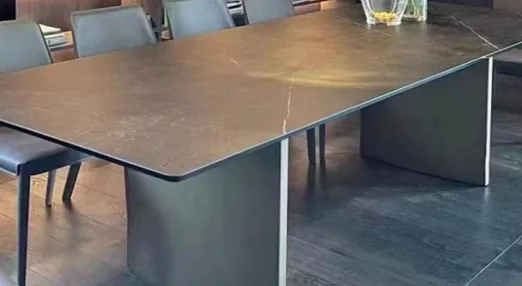
Corners get rounded
A square corner on a dining table is a hazard at child height and the first thing to chip. We radius corners as standard unless your drawing says otherwise, usually R10 to R30 depending on the size of the top.

Underside matters
The underside edge is chamfered so it is comfortable to sit against and does not chip when the table is moved. On a countertop nobody ever touches it.
Edges for stone table tops
Table tops take a different edge from worktops. On a 15 or 20 mm top the whole profile is visible from a seated position, and a heavy profile makes a table look clumsy.
Eased
The cleanest line on a thin top, and what most contemporary tables use.
Half bullnose
Softer where forearms rest on the edge through a long meal.
Full bullnose
Turns the whole edge into one radius. Reads thinner than it is.
Mitred build-up
Makes a 20 mm top read as 40 or 60 mm without the weight of solid stone.
Laminated bullnose
A bonded strip under the edge with a radius top and bottom, built up to 40 mm — the French edge. On a table the whole perimeter is seen and touched, so the double radius is kinder than a square built-up edge, and it adds the least weight for the look.
Mitred edges on tables need a word of warning. A built-up edge doubles the perimeter weight of the top, which is exactly where the base is least able to carry it. On a round pedestal table it also raises the centre of gravity. We will quote it, but on a top over 1600 mm we will ask which base you are using first.
Marble table top, cut from slabs we hold
Marble is the top most people picture when they say stone table. It is cut to any shape from slabs we hold, and it carries the widest pattern choice of any material we stock.
The limit to know is span. Marble is heavier per square metre than porcelain and its veining concentrates stress, so on the same base a marble top is rated for a smaller unsupported size. Every model in our stone table base catalogue lists both figures side by side.
Material for a table you eat at
| Material | On a dining table | Weight on the base | Verdict |
|---|---|---|---|
| Porcelain | Non-porous, takes a hot dish straight from the oven, and the thinnest material we can make a big top in | Lightest of the five — carries further on the same base | The best material for a large table. Also the only one that works at 12 mm on a 2 m top |
| Quartz | No sealing, wipes clean, colour consistent across a set of tables | Moderate | The right choice for a restaurant ordering twenty matching tables |
| Marble | The reason people want a stone table. Also etches from lemon, vinegar and wine within minutes | Heaviest — restricts which bases are in range | For clients who accept a patina. Honed rather than polished hides etching better |
| Granite | Hard, heat-tolerant, forgiving. Sealed once a year | Heavy | Suits large tables where appearance is secondary |
| Cultured marble | Even colour and chip, consistent across many tables | Moderate | Suits a hotel or chain rolling out the same table |
Weight is not a detail on a table. It decides which bases you can use and whether two people can carry the top into a dining room. A 1600 × 900 mm top in 20 mm marble weighs roughly 80 kg; the same top in 12 mm porcelain is about 42 kg. For restaurant work where staff move tables to reconfigure a room, that difference matters more than any surface property.
For marble and granite tops, ask for the heavy-duty base models rather than the slimmest one that looks right. Granite suits busy settings where the surface has to take knocks.
Quartz suits a table that has to match a countertop already specified, cut from the same slab run. Some specifications still call porcelain sintered stone; it is the same material under the name the Chinese national standard now uses.
Stone table tops cut to size, or tops on their own
We supply tops on their own, tops with our table bases, or the complete stone table: priced as a table, packed in the same container, one set minimum, 30 days, shipped flat.
Two kinds of order come in constantly and both are straightforward, so it is worth saying plainly that we do them.

Cut to size
Send a dimension, a shape or a drawing and we cut to it. There is no standard size list to choose from, because every top is cut from a full slab against your drawing anyway.
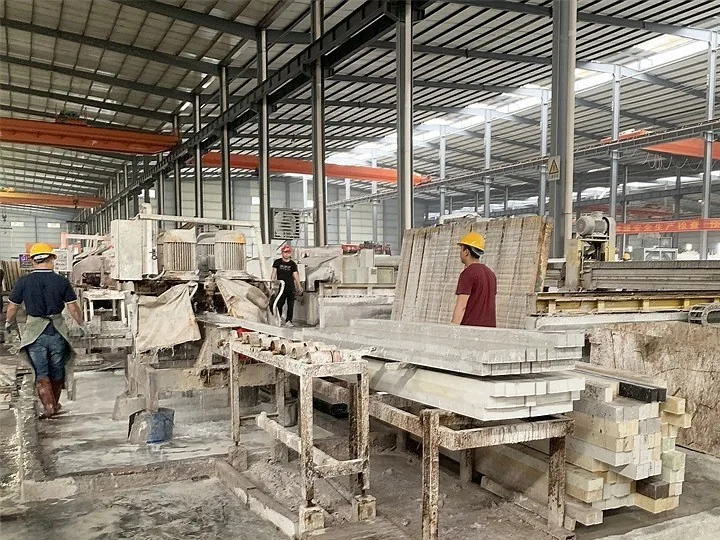
Tops only, no bases
Send the fixing centres of the bases you have — the distance between the fixing points and the plate size — and we drill and counterbore the backing board to suit. This is how most restaurant and hotel orders work, because the client already has bases or buys them locally.

Replacements
A damaged top on an otherwise good table is worth replacing rather than scrapping the table. Send the old dimensions and the fixing positions, and a photograph of the underside so we can see how it was fixed.

Matching an existing set
If you are adding tables to a room that already has ours, quote the original order number. We will cut from the same design and tell you honestly if the batch has moved, rather than shipping tables that do not match the ones already in the room.
Checks and packing

Table tops are the most fragile thing we ship — thin, unsupported at the edges, and with a hole or fixing points in the middle where the base goes.
Backing board bonded
Checked for full contact across the whole panel. A void in the bond is where a top cracks later.
Fixing points verified
Drilled and counterbored to the base you are using, or to the fixing centres you sent us. Checked against an actual base where we supply it.
Edge and corners
Whole perimeter inspected at eye level under daylight, because that is how it will be seen. Corner radii checked against the drawing.
Segments dry-assembled
On tops over 1500 mm the segments are assembled and the joints photographed before packing.
Flat in the crate
Unlike counters, table tops travel flat and fully supported, because a round top stood on edge concentrates all its weight on one point of the rim.
Bases packed separately
Bases ship in their own cartons, one or two per base, with the assembly hardware. They are not fitted to the tops before shipping.
From sizes to loaded container
Tell us seats or sizes
Either works. A seat count is enough to start — we come back with the size that suits it and the bases that carry it.
We return a drawing
Top size and shape, edge profile, corner radii, fixing positions, and the base model if you are taking ours.
You sign it
Nothing is cut before the drawing comes back signed.
Production and loading
Thirty days from the signed drawing. Tops and bases packed in the same container.
| Terms | What we offer |
|---|---|
| Minimum order | No fixed minimum. Below roughly a pallet the freight per table stops making sense, and we will say so |
| Lead time | 30 days from the signed drawing |
| Price basis | FOB Shenzhen or Guangzhou |
| Tops without bases | Normal. Send the fixing centres of your own bases |
| Bases without tops | Available. We make the bases in our steel workshop, and they ship best together with our tops |
| Mixing | Tables, countertops and slabs can share one container |
Questions about stone table tops
Quartz table top vs granite: which should you choose?
For a set of restaurant tables, quartz: it needs no sealing, wipes clean, puts a moderate weight on the base, and tables cut from one production batch match each other. Granite is hard, heat-tolerant and forgiving, so it suits busy settings where the top takes knocks, but it is heavy, is sealed once a year and calls for our heavy-duty base models. Granite is economical for large tables where appearance is secondary.
Is a marble top dining table good?
Yes, for a client who accepts a patina. Marble is the classic stone for a table, but lemon, vinegar and wine etch it within minutes, so a honed finish, which hides etching better than polished, is the practical choice for dining. It is also the heaviest of the five materials we cut, so ask for a heavy-duty base, and expect a smaller maximum top size than porcelain on the same base.
Which stone is best for a restaurant table?
Porcelain if staff move and reconfigure the tables: a 1600 × 900 mm top is about 42 kg in 12 mm porcelain against roughly 80 kg in 20 mm marble, and it takes a hot dish straight from the oven. Quartz where twenty tables have to match, cut from one production batch. Cultured marble suits a hotel or chain rolling out the same table, and marble only where the client accepts that lemon and wine will etch it.
Do you supply the table bases, and what is the minimum order?
Yes. We make more than 100 base models in our steel workshop, so you can order complete tables from one set, or tops only. Finished tops have no fixed minimum, but below roughly a pallet the freight per table stops making sense, and we say so. Slabs bought loose sell from one slab when in stock, while a made-to-order run needs a container mixing up to five colours. Each base takes a larger top in porcelain than in marble, so tell us the material and size together.
What size dining table do I need for 6 people?
A rectangular top of 1400 to 1600 mm by 800 to 900 mm, or a round top of 1200 to 1300 mm. Allow 600 mm of table edge per person, or 700 mm if people sit through long dinners. For 8 people, go to 2000–2200 × 1000 mm rectangular or a 1500 mm round. Round tops larger than 1500 mm seat more but need a lazy susan to reach the middle.
What is a sintered stone table top?
A sintered stone table top is a porcelain top under its other name; the Chinese national standard now uses the porcelain name. On a dining table it is the lightest of the five materials we cut, so it carries further on the same base, and it is the only one that works at 12 mm on a 2 m top. It takes a hot dish straight from the oven, and like every top we ship it has a bonded backing board.
How to care for a marble or stone-top dining table?
Care depends on the stone. Marble etches from lemon, vinegar and wine within minutes, so put coasters under glasses, blot spills at once and choose a honed finish, which hides etching better than polished. Granite is sealed once a year. Quartz needs no sealing and wipes clean, and porcelain takes a hot dish from the oven. On the natural stones, a trivet or mat under hot dishes is still the safer habit.
How to clean a marble top dining table?
After a meal, wash the top with warm water and a mild dishwashing liquid or a neutral stone cleaner, rinse it, and dry it with a soft cloth. If wine, lemon or vinegar lands on it, blot rather than wipe, because wiping spreads the spill and acids etch marble. Keep vinegar-based sprays and scouring powders off it, and never mix ammonia with bleach for any stone.
Related

Bar Tops
Bar, counter and table heights with the overhang carried on steel.
Reception Counters
Three heights, an ADA section, and jointed long runs.

Quartz Slabs
A wide range of designs, photographed slab by slab.

Contact Us
Send seat counts or sizes and get a drawing back.